A Considered Approach to Autumnal Transition
As summer draws to a close, the transition into autumn presents an important opportunity for private households to refresh, reorganise and refine the home. For UHNW families, seasonal change is rarely limited to putting away summer linens and bringing out warmer textiles. It is a carefully coordinated process encompassing household presentation, preventative maintenance, wardrobe rotation, entertaining preparation and, increasingly, sophisticated seasonal decoration.
For a domestic staffing agency, autumn is also a particularly valuable period for demonstrating the difference between routine housekeeping and genuinely exceptional household management. A well-prepared residence should feel effortless: beautifully presented, appropriately stocked, meticulously maintained and ready for the family’s changing routines before they have to ask.
Autumn spring cleaning—whether undertaken as a comprehensive seasonal reset or incorporated into the household’s regular maintenance programme—provides an ideal framework for achieving this.
The Changing Expectations of Luxury Domestic Service
The modern UHNW household increasingly expects domestic staff to operate proactively rather than reactively. A housekeeper, estate manager, personal assistant or private chef may each have distinct responsibilities, but seasonal transitions work best when they are approached collaboratively.
Today’s luxury household is likely to place particular value on:
Discretion and continuity: seasonal work should be completed with minimal disruption to the principal’s schedule and privacy.
Attention to detail: everything from linen storage to candle placement should reflect the household’s established standards.
Preventative care: seasonal cleaning should identify maintenance issues before they become costly problems
Personalisation: decoration, scent, table settings and guest arrangements should reflect the family’s preferences rather than generic seasonal trends
Efficient household management: inventories, storage systems and purchasing should be carefully controlled.
Anticipation: exceptional staff identify what will be required several weeks ahead and prepare accordingly.
This proactive mindset is particularly important in larger residences, where seasonal change can involve multiple bedrooms, entertaining spaces, staff areas, wardrobes, outdoor facilities and secondary properties.
The Autumn Household Reset
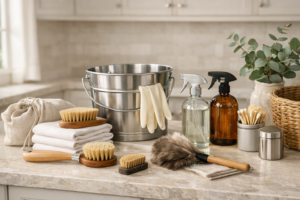
A successful seasonal clean should begin with a review of the property rather than immediately reaching for cleaning products.
1. Assess Before You Act
The household team should establish what has changed since the previous season. Which rooms have been heavily used? Are there textiles requiring specialist cleaning? Have any furnishings, finishes or decorative objects suffered wear? Are storage areas becoming congested?
A room-by-room assessment allows staff to prioritise work and prevents unnecessary duplication.
For larger residences, it can be useful to divide responsibilities into:
principal and family areas;
guest accommodation;
formal entertaining spaces;
informal living areas;
kitchens and service areas;
staff accommodation;
storage and linen rooms;
outdoor and transitional areas.
The objective is not simply cleanliness. It is to restore the property to a polished state appropriate to the family’s autumn routine.
2. Rotate Textiles and Linens
Autumn is an appropriate time to introduce heavier duvets, blankets, throws and seasonal bed linens while carefully storing summer items.
Luxury textiles require particular consideration. Cashmere, wool, silk, fine cotton and embellished fabrics may require specialist laundering or dry cleaning. Staff should follow manufacturer instructions and household protocols rather than assuming that expensive materials can be treated in the same manner as everyday fabrics.
Storage should also be clean, dry, appropriately ventilated and clearly organised. Proper rotation protects the household’s investment in its linens while making future seasonal changes considerably more efficient.
3. Review Wardrobes and Dressing Areas
The seasonal transition should extend beyond the linen cupboard
Wardrobe teams and housekeepers may coordinate with personal assistants or private stylists to facilitate:
seasonal wardrobe rotation;
professional cleaning and repairs;
shoe and accessory care;
luggage and travel preparation;
identification of missing or replacement items;
appropriate storage of summer garments.
For principals who travel frequently between residences or climates, careful labelling and inventory control can be particularly valuable.
Seasonal Decoration: Elegant Rather Than Excessive
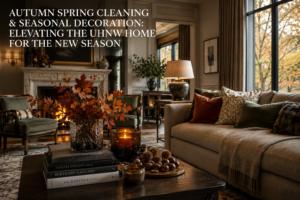
Autumn decoration in a luxury residence is most effective when it feels intentional and architectural rather than themed
A restrained palette of natural materials can create warmth without compromising the property’s existing aesthetic. Seasonal branches, foliage, sculptural arrangements, textured throws, understated tableware and carefully selected candles can introduce autumnal character while maintaining a sophisticated environment.
The guiding principle should be curation rather than accumulation.
Consider the Architecture
Decoration should complement the residence rather than compete with it. A historic country estate may accommodate richer textures and traditional arrangements, while a contemporary city residence may benefit from restrained botanical elements and sculptural pieces.
Staff should understand the family’s preferences and the property’s design language before introducing seasonal changes.
Think About Scent
Scent can be an effective component of seasonal atmosphere, but it requires particular sensitivity in a luxury household.
Autumn-inspired fragrances can include woody, amber, fig, cedar, subtle spice or natural botanical notes. However, fragrance should never be introduced indiscriminately. Some principals and guests may have sensitivities or strong preferences, and scented products should be used only in accordance with household instructions.
Prepare for Entertaining
Autumn often brings an increase in dinners, weekend guests and informal gatherings. Seasonal preparation should therefore extend to entertaining areas.
Staff can review:
table linens and napery;
formal and informal tableware;
glassware and serving pieces;
candles and decorative accessories;
guest towels and amenities;
spare seating and blankets;
dining room presentation;
pantry and drinks inventories;
guest-room readiness.
The best preparation is invisible. Guests should experience a home that feels naturally ready to receive them.
Compliance and Professional Standards
Seasonal cleaning and decoration also require a disciplined approach to compliance, particularly when domestic staff are engaged professionally.
Health and Safety
Cleaning products should be stored and used according to manufacturer instructions, with appropriate attention to ventilation, dilution, labelling and safe storage. Staff should never mix incompatible cleaning chemicals.
Where specialist cleaning equipment is used, employees should receive appropriate instruction and follow household risk assessments and operating procedures.
Manual Handling and Working at Height
Seasonal decoration frequently involves lifting boxes, moving furniture or accessing high storage areas. Employers and household managers should ensure that staff are not placed at unnecessary risk.
Appropriate equipment should be provided for tasks involving height, and staff should not improvise by standing on unsuitable furniture or unstable surfaces.
Specialist Items and Valuable Property
Fine art, antiques, delicate finishes and valuable decorative objects should not be treated as ordinary household items. Where there is uncertainty, the correct approach is to consult the appropriate specialist, conservator, designer or household manager rather than risk damage.
A luxury staffing service should encourage a culture in which staff are expected to pause and escalate when a task falls outside their competence.
Employment and Record Keeping
Employers and agencies should ensure that domestic staff arrangements comply with applicable employment, tax, working-time, insurance and health-and-safety obligations.
From an agency perspective, clear job descriptions, appropriate training, documented procedures and reliable communication between the household and staffing provider are essential. Compliance should be embedded into service delivery rather than treated as an administrative afterthought.
Because regulations and individual circumstances vary, households should obtain appropriate professional advice on employment and legal matters where necessary.
Advice for Clients: Make Seasonal Preparation Proactive
For clients, the most effective approach is to begin planning before the seasonal change becomes urgent.
A household manager or staffing agency can add considerable value by creating an annual seasonal calendar covering:
Six to eight weeks ahead
Review previous seasonal inventories.
Identify repairs, specialist cleaning and replacement requirements.
Confirm decoration preferences.
Schedule external specialists where necessary.
Three to four weeks ahead
Rotate non-essential textiles.
Arrange wardrobe and footwear care.
Order approved seasonal items.
Review entertaining requirements.
Inspect guest accommodation.
One to two weeks ahead
Complete detailed cleaning.
Install seasonal textiles and decorative pieces.
Finalise pantry and household inventories.
Prepare entertaining spaces.
Address outstanding maintenance.
During the season
Monitor wear and replenish supplies discreetly.
Maintain decoration rather than allowing it to become cluttered.
Record items requiring attention before the next seasonal transition.
This approach converts seasonal cleaning from a reactive project into an integrated element of household management.
Advice for Candidates: Demonstrate Initiative and Discretion
For domestic staff and candidates, seasonal transitions offer an opportunity to demonstrate professional judgement.
Strong candidates should be able to show that they can:
Plan ahead rather than wait for instructions.
Prioritise tasks according to the principal’s preferences and schedule.
Handle luxury materials and furnishings appropriately.
Maintain confidentiality and discretion throughout the process.
Communicate potential issues promptly.
Work collaboratively with other household staff and external specialists.
Keep accurate inventories and records.
Understand the boundaries of their role and seek guidance where appropriate.
A candidate who simply completes a list of cleaning tasks may be competent. A candidate who notices that a guest bedroom requires additional preparation before an upcoming visit, identifies a damaged textile before storage, and alerts the household manager to a maintenance issue demonstrates something more valuable: anticipatory service.
That distinction is central to luxury domestic staffing.
The Role of the Staffing Agency
For an agency, autumn preparation is an opportunity to reinforce its position as a strategic partner to the household.
Rather than viewing seasonal cleaning as an isolated housekeeping requirement, agencies can help clients coordinate the wider household operation. This may involve recommending appropriately skilled temporary or permanent staff, helping define seasonal responsibilities, facilitating communication between household teams and ensuring that expectations are clearly established.
Agencies should also recognise that every UHNW household operates differently. A private residence with a large permanent team will have different requirements from a family employing a smaller household staff across several properties.
The highest level of service therefore comes from understanding the household’s individual operating model rather than imposing a generic seasonal programme.
A Final Thought: The Luxury of Effortlessness
Autumn preparation is ultimately about more than cleaning and decoration. It is about creating an environment in which the household can move naturally into the next season without interruption.
The finest homes rarely announce how much work has gone into preparing them. The result simply feels right: rooms are warm and immaculate, guest accommodation is impeccable, wardrobes are organised, entertaining spaces are ready, valuable possessions have been carefully protected and seasonal details appear considered rather than contrived.
For UHNW clients, that sense of effortless perfection is one of the defining characteristics of exceptional domestic service.
For professional household staff, autumn spring cleaning is therefore not merely another task on the calendar. It is an opportunity to demonstrate foresight, discretion, technical competence and an instinct for service—the qualities that transform excellent household support into truly exceptional private service.